How to Make Money With Affiliate Marketing as a Content Creator (Without a Big Audience)

Scott Caputo
Make Money on Social Media

Most people assume affiliate marketing is a numbers game — that you need a massive audience before any meaningful commission shows up. That assumption keeps a lot of small creators from starting at all, which is a shame, because the mechanics of affiliate marketing actually favour focus over scale.
Unlike brand deals (where you're often paid a flat fee for reach) or clipping (where payment ties to view counts), the affiliate model pays you when someone you referred makes a purchase. That means a niche audience of 1,500 engaged followers who trust your recommendations can outperform a 200,000-follower account full of passive scrollers.
Here's a practical breakdown of how to set yourself up, pick the right products, understand how your commissions are tracked, and stay honest with yourself about what to expect.
Why Affiliate Marketing Is Different From Other Creator Income
Brand deals and clipping are both performance models — but they pay for content delivery, not sales outcomes. Affiliate marketing is the reverse: the content is just the vehicle. The commission arrives when a real purchase happens.
That shift has a few meaningful implications for small creators:
No follower threshold. Programs don't have a minimum audience requirement the way brand deals sometimes do. You earn when someone converts, full stop.
Evergreen potential. A well-written review or a short video with your affiliate link in the caption can keep generating commissions months after you posted it.
Higher earning per conversion. Because commissions are percentage-based, a single sale of a $300 SaaS subscription at 25% recurring commission earns more than several thousand views on a clipped video.
About 31% of content creators rank affiliate marketing as a top revenue stream, ahead of ad revenue and one-off sponsorships, according to 2026 data compiled by Hostinger. The category is also growing fast — creator affiliate revenue grew 47% year-over-year in 2026 and now accounts for roughly 24% of total affiliate spend globally, up from 11% in 2022, per Digital Applied's 2026 data compilation.
That growth isn't coming from mega-influencers. It's coming from smaller creators who pick their niche tightly and recommend products their audience actually uses.
How to Pick the Right Products (The Commission Framework)
The biggest mistake new affiliates make is signing up for whatever program is easiest to find — usually a large retail network with 4–8% commissions on physical goods. Those commissions aren't wrong, they're just unforgiving when your audience is still small. One sale of a $40 item at 5% nets $2. That math only works at scale.
For small creators, the smarter move is to start with categories where the commission rate compensates for lower volume:

Higher commissions and longer cookie windows give small creators more room to earn per conversion. Ranges are 2026 network benchmarks; individual programme terms vary.
SaaS and software offer the most favourable economics for small creators. Programs typically pay 20–50% recurring commissions per sale, meaning you earn every month a customer you referred stays subscribed. Tapfiliate's 2026 benchmark across 2,600+ programs puts the SaaS recurring rate at 20–30% as a standard entry point.
Digital products and online courses come second. Median commission sits around 35%, cookie windows run 60 days (meaning someone can browse for two months before buying and you still get credited), and conversion rates are reasonable for audiences with learning intent.
Ecommerce and DTC brands pay 10–15% on first orders with tier bumps for top performers, according to ReferralCandy's 2026 industry data. Not bad if the product price is high — but watch the cookie window. About 38% of ecommerce programs run cookie windows of 7 days or fewer, which is a real risk when audiences browse slowly.
The three questions to ask before joining any program:
What is the commission rate, and is it recurring or one-time?
How long is the cookie window?
What does the product cost, and would my audience realistically buy it?
Niche fit matters as much as commission rate. A 40% commission on a product your audience has no interest in converts at near zero.
How Affiliate Tracking Actually Works
This is the part most guides skip, and it's worth understanding before you start — especially if you're posting to video platforms.
When someone clicks your unique affiliate link, the program places a small cookie in their browser that identifies you as the referrer. If they purchase within the cookie window (24 hours for Amazon, 30–90 days for most other programs), the sale is attributed to you and a commission is recorded.
The practical catch: browsers actively interfere with this. Safari's Intelligent Tracking Prevention and Firefox's Enhanced Tracking Protection remove a meaningful share of cookies — estimates put that figure at 30–35% of trackable traffic, according to irev.com's 2026 cookieless tracking guide. That means some purchases you drove may never be attributed to you, depending on which browser your audience uses.
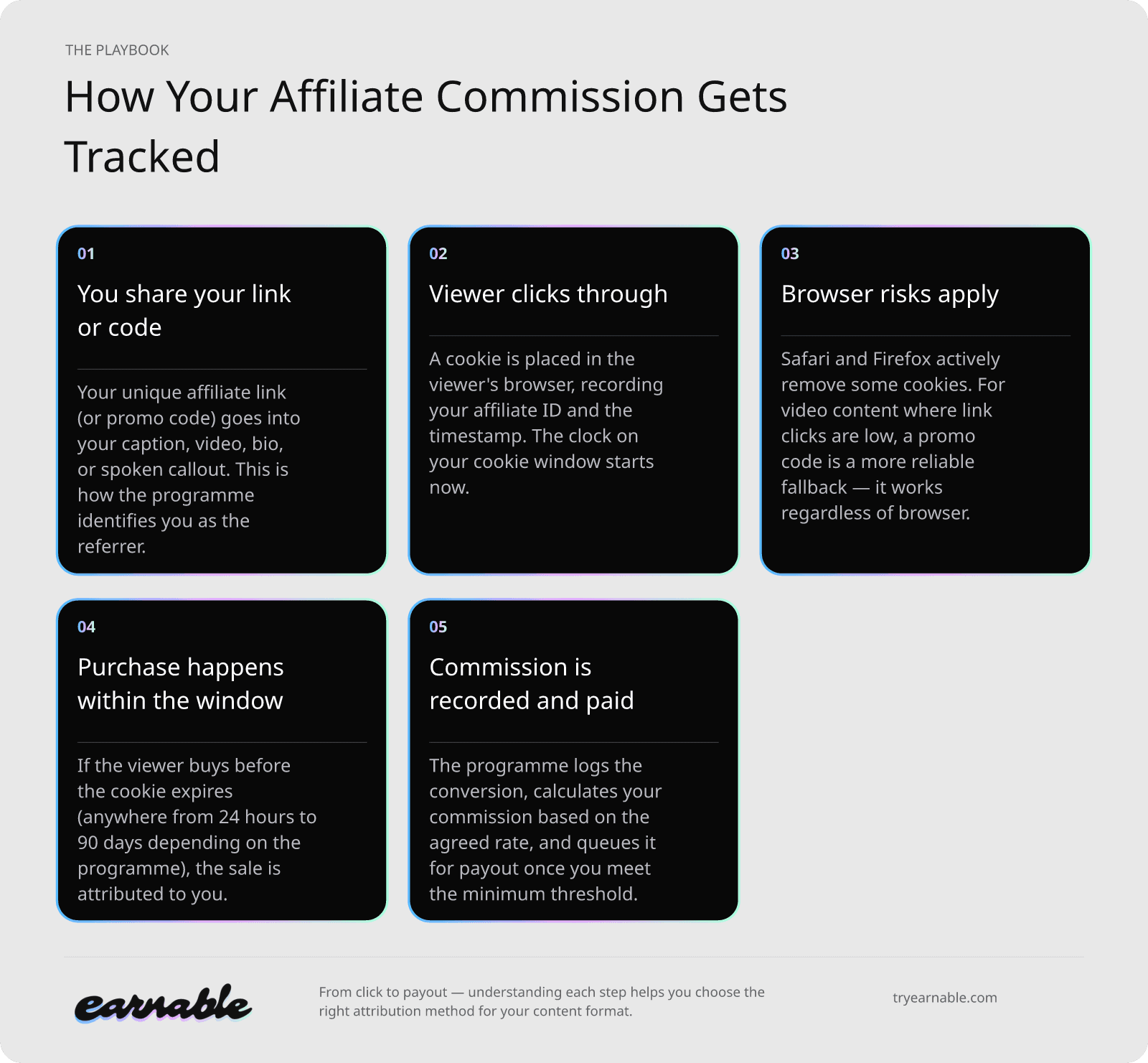
From click to payout — understanding each step helps you choose the right attribution method for your content format.
What this means in practice:
Standard affiliate links work fine for blog posts and newsletter placements, where clicking through is natural. Use them by default.
Promo codes are the most reliable attribution method for video content — they're fully independent of browsers and cookies, and they survive screenshots and word-of-mouth sharing. If a program offers a code option, take it.
Server-to-server (postback) tracking is the most technically accurate method (above 98% accuracy regardless of browser state), but it's set up on the program's side, not yours. It's worth knowing it exists so you can ask programs whether they use it.
For short-form video in particular — TikTok captions, YouTube Shorts descriptions, Reels — push your promo code into the video itself, not just the link in bio. Viewers watching vertically often don't click through; they search later. A memorable code captures that deferred intent.
A Realistic Earnings Picture
Honesty here matters. The range in affiliate income is genuinely wide.
About 41% of affiliates earn under $1,000 per month. Roughly 80% earn up to $80,000 per year in total; the top 10% of affiliates generate close to 90% of network revenue, according to irev.com's 2026 industry statistics. Survey-based data from Authority Hacker shows that established affiliates in high-value niches — e-learning, travel, beauty — earn significantly more, but those are averages for people with years of content and SEO behind them.
For a first-year small creator, a realistic expectation is $100–$500 per month after 12–18 months of consistent content, assuming you've picked programmes with competitive commissions and you're creating content with genuine purchase intent behind it. That timeline shortens if you're already in a high-conversion niche (software, education, finance) and lengthens if your content doesn't naturally lead to buying decisions.
The thing affiliate income has going for it that brand deals don't: it compounds. A piece of content you published eight months ago can still be generating commissions today. Every post you add increases the surface area for conversions, even when you're not actively promoting.
Your First 30 Days: A Practical Playbook
Don't try to run five programmes at once. Pick one, execute it well, and understand the reporting before adding more.
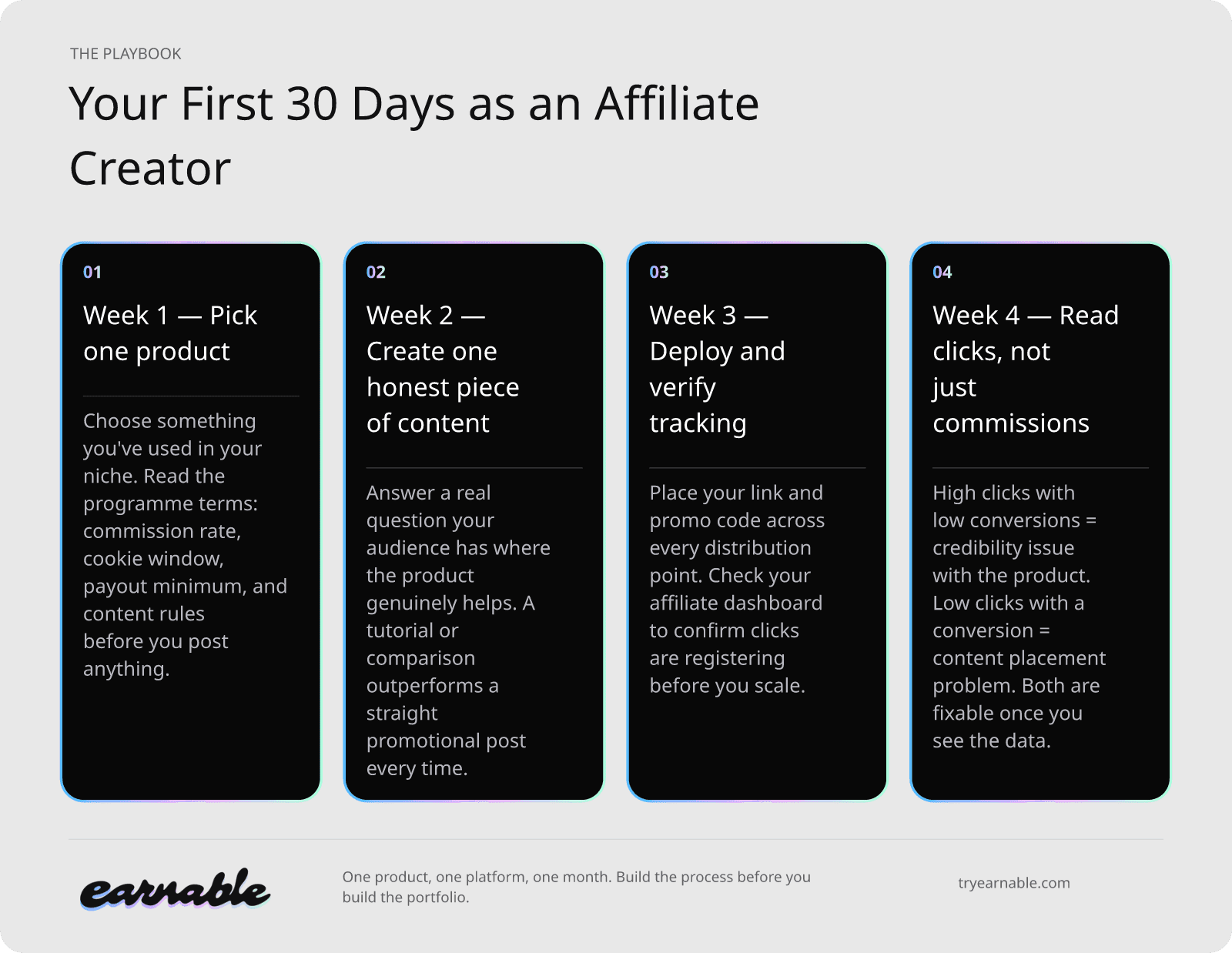
One product, one platform, one month. Build the process before you build the portfolio.
Week 1 — Pick one product and one platform. Choose something you've actually used in your niche. Sign up for its affiliate programme directly or through a network (ShareASale, Impact, PartnerStack are common for creator-friendly programmes). Read the terms: commission rate, cookie window, payout minimum, and content guidelines.
Week 2 — Create one honest piece of content. This doesn't mean a polished ad. It means content that answers a real question your audience has, where the product genuinely helps. A tutorial, a comparison, a before/after — something with actual information in it. Audiences that feel sold to stop clicking; audiences that feel helped keep coming back.
Week 3 — Add your tracking. Place the affiliate link (and promo code if available) in every distribution point: the caption, the pinned comment, the bio link. For video, say the code out loud. Check your affiliate dashboard to confirm your link is active and clicks are registering. A single sale confirms the whole attribution chain works.
Week 4 — Read the data, not the commissions. Look at clicks, not just earnings. A post with 400 clicks and $0 commission tells you something different from a post with 12 clicks and one conversion. The click-through rate tells you whether your recommendation is credible; the conversion rate tells you whether the product is a fit.
Repeat and expand only once you have a baseline you can improve.
Where Earnable Fits In
Tracking affiliate commissions across multiple programmes, platforms, and payout schedules is the part that usually breaks down for new creators — not the content itself. Briefs get buried in emails, payment schedules vary by programme, and you often don't know if a post drove sales until weeks later.
Earnable's platform is built around exactly this problem. The "partner on sales" earn model centralises campaign discovery, delivery, and tracking in one place — including views, clicks, and the sales your content actually drove. Every campaign is funded before you post, which removes the payment uncertainty that independent affiliate arrangements often carry.
If you're starting out with affiliate marketing and want the operational side handled so you can focus on the content, Earnable is worth a look.