What Is Content Clipping? A Practical Guide for 2026

Scott Caputo
Clipping Guides

Most people hear "clipping" and picture someone trimming a video file on their laptop. That's the edit. What content clipping actually means in 2026 is something bigger: a distribution strategy that turns long-form source content into short vertical videos built for TikTok, Instagram Reels, and YouTube Shorts and pays creators for the reach those clips deliver.
If you're a creator wondering whether clipping is a real income stream, or a brand trying to understand why your long-form content isn't finding new audiences, this guide explains both sides clearly.
What content clipping actually means (and what it isn't)
Clipping is not just repurposing. Repurposing is one team taking one video and cutting it down for one other channel. Clipping as a distribution strategy is a coordinated system where many independent creators each take approved source content, find the strongest moments, add their own creative spin, and publish short-form versions from their own accounts across multiple platforms simultaneously.
The source content can be almost anything: a livestream, a brand launch video, a podcast, a founder interview, a product demo, or event footage. The goal is to give that content dozens of different hooks and dozens of chances to reach new audiences who would never sit through the original.
Think of it less as an editing service and more as a distributed creative testing system. Each clipper is running a small experiment: which moment travels? Which hook stops the scroll? The campaign data answers those questions at scale.
The two layers: the edit and the campaign
Every clipping opportunity has two distinct layers, and mixing them up causes most beginner mistakes.
Layer 1 — The editorial act. This is the craft: finding a surprising reaction, a useful explanation, a funny exchange, or a story with a clear beginning and payoff. A good clip gives viewers enough context to care, a reason to keep watching, and something worth sharing. Editorial judgment knowing which 30 seconds out of a 90-minute stream actually lands is the skill that separates good clippers from average ones.
Layer 2 — The paid campaign. This is the distribution layer built on top of that craft. A brand or creator sets up a campaign, defines which footage is approved and how it can be edited, and pays clippers based on the performance of their published clips. The written agreement rate, verified-view rules, minimums, payout caps, review periods determines what you earn. There is no universal clipping rate; the brief tells you everything.
Understanding both layers matters because the editorial skill is transferable across many campaigns, while each campaign's commercial terms are unique.
Why brands are paying creators to clip their content
Long-form content has a discovery problem. New audiences don't find a brand through a 90-minute vide they find it through a 60-second clip, get interested, and go looking for the longer content on their own. Clipping creates that first touchpoint at scale, and it does it through real people posting from real accounts rather than through ad placements.
For brands, the real value is not simply producing more videos. A well-run clipping campaign helps a brand learn which hooks, stories, and messages attract the right audience across platforms, in real time, at a cost tied directly to verified reach rather than impressions or clicks.
That's why large brands are increasingly coordinating pools of independent creators to cut their content launches, interviews, event footage, product demos into short vertical clips posted across TikTok, Reels, Shorts, and X, from the creators' own accounts, paid on the reach those clips actually deliver.

Five steps from brand brief to creator payout each stage has a clear owner and a defined output.
What makes a clip worth watching and worth paying for
Effective clipping is more than cutting a recording into smaller pieces. Each clip needs a clear idea, enough context, and a reason for viewers to keep watching. The key metric across all three major short-form platforms is completion rate not arbitrary length.
Platform guidance as of 2026 gives creators a practical starting framework:
TikTok: Maximum 10 minutes, but 15–34 seconds drives the highest completion rates. Clips over 60 seconds unlock monetisation eligibility.
Instagram Reels: Maximum 3 minutes. 7–15 seconds delivers the broadest reach; 30–60 seconds works better for content people want to save.
YouTube Shorts: Maximum 3 minutes. The sweet spot for completion and algorithmic push sits around 15–40 seconds.
Across a sample of 3.3 million videos analyzed between October 2025 and August 2026, the median TikTok video ran 16 seconds, the median Reel 18 seconds, and the median YouTube Short 19 seconds. Creators who hit those windows aren't padding or cutting arbitrarily they're matching natural attention spans on each platform.
Beyond length, a strong hook in the first two seconds is non-negotiable. If the opening frame doesn't give someone a reason to keep watching, the algorithm won't push the clip far enough for anyone to find out how good the rest of it is.

Optimal clip lengths vary by platform. Completion rate not raw length is the metric that drives algorithmic reach on all three.
How a clipping campaign works, step by step
The mechanics are straightforward once you see the full sequence.
A brand supplies approved source content alongside a brief — what to emphasise, what to avoid, which platforms are approved for posting. Clippers browse available campaigns, check their eligibility (account type, audience size, region, age requirements), and apply. Every campaign on a properly run platform is funded before any clipper starts work, so there's no chasing payment after the fact.
The clipper selects a moment, edits a vertical clip with captions and a strong hook, and submits it for review. The operator approves or requests revisions before the clip goes live. Once published, views are tracked in real time. Payment follows based on the campaign's verified-view or fixed-fee structure exactly as described in the brief.
One reported example: Tubefilter noted in April 2026 that the N3on campaign on Kick paid $40 per 100,000 views, sometimes rising to $50. That's a single reported arrangement not a platform-wide standard or an Earnable rate. Every campaign sets its own terms, and reviewing those terms before you invest your editing time is the most important habit a new clipper can build.
The Earnable guide on streamer clipping puts it plainly: a first month can produce little or no income, and another creator's results are not a reliable forecast for your own account. Start with one campaign, learn the approval and payment process end to end, then take on more.
Who can become a clipper and what to do next
Unlike traditional influencer work, clipping rewards editorial judgment and distribution reach rather than follower count. Many campaigns accept creators with small or new accounts; the brief specifies eligibility, and some opportunities are genuinely open to beginners.
What you need to start is simple: a social account on an eligible platform, a basic editing setup (a phone is often enough for short clips), and the discipline to read the brief carefully before you start cutting.
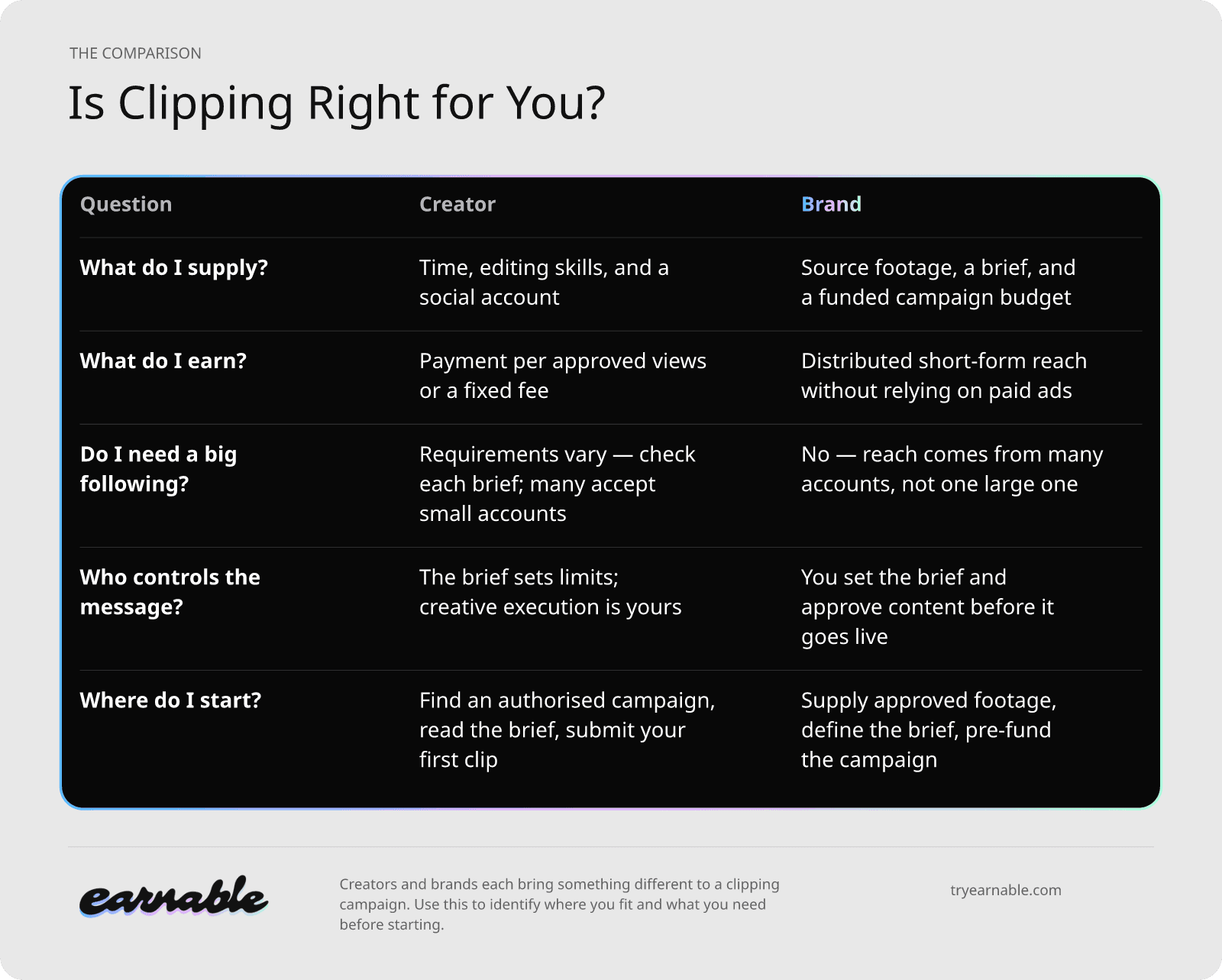
Creators and brands each bring something different to a clipping campaign. Use this to identify where you fit and what you need before starting.
On the brand side, the entry point is equally direct: supply your source footage, define what you want clippers to emphasise, fund the campaign, and let the platform handle brief delivery, approval workflows, and payment.
Earnable is built around exactly this exchange creators who clip for pay, and brands that need distributed reach without relying on ads. Briefs, approvals, revisions, and payments all live in one place, so nothing gets lost in a DM and every campaign is funded before anyone starts posting.
If you want to go deeper on the streamer side specifically finding authorized Kick and Twitch programs, understanding submission rules, and navigating payout structures the Earnable guide to becoming a clipper for streamers covers all of it.
Otherwise, the next step is simple: browse open campaigns on Earnable and read your first brief. Everything else follows from there.
Sources: Earnable – Get Paid to Post Online · How to Become a Clipper for Streamers | Earnable · Ideal Video Length for Every Platform (2026) · Short-Form Video Trends 2026: Data From 3.3M Videos · Short-Form Video Strategy: Shorts vs TikTok vs Reels